
- News
- 0 likes
- 678 views
- 0 comments
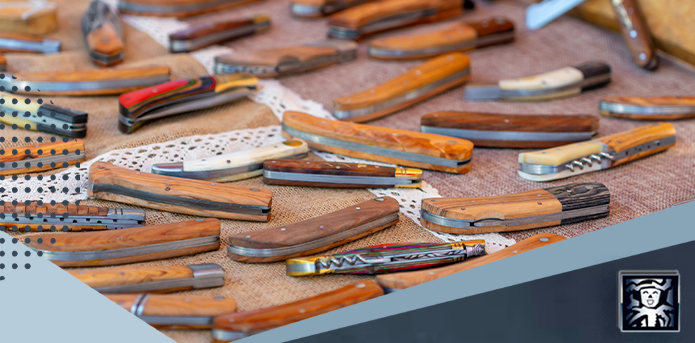
The Pocketknife as a Symbol of the Albacete Fair
When we think of the Albacete Fair, it is easy to picture the Puerta de Hierros, the Fairgrounds, the famous miguelitos, the food stalls, the attractions or the traditional walks around the Redondeles. But there is another element deeply connected to the identity of the city: the Albacete pocketknife.
Cutlery and knife-making have been part of Albacete’s history and culture for centuries, and during the Fair, this tradition takes on a particularly prominent role. Among craft stalls, shops and spaces dedicated to knife-making, the Albacete pocketknife remains one of the most representative souvenirs that visitors and locals can take home from the festivities.
It is no coincidence that Albacete’s cutlery tradition and classic pocketknife have been officially recognised as an Asset of Cultural Interest (BIC) in the category of Intangible Cultural Heritage. This recognition highlights the importance of an artisanal tradition that has been passed down through generations.
The Albacete Pocketknife: Much More Than a Tool
The history of knife-making in Albacete dates back several centuries. The Municipal Museum of Cutlery places the earliest documentary references to the city’s knife-makers and swordsmiths as far back as the 15th and 16th centuries, while the use of pocketknives became widespread during the 17th century.
Over time, the Albacete pocketknife developed its own distinctive characteristics and became one of the city’s most recognisable products. Its importance goes far beyond its original practical purpose: it represents a craft, a way of life and an essential part of Albacete’s cultural heritage.
In fact, the Castilla-La Mancha Cultural Heritage Portal highlights how closely the image of a community can become associated with a particular artisanal product, as is the case with Albacete and its pocketknife.
The Albacete Fair and the Tradition of Buying a Pocketknife
The Fair has always been closely linked to trade and to the tradition of buying products during the festivities. Although the Albacete Fair has changed considerably since its origins, the custom of purchasing and taking home a souvenir remains an important part of the experience.
Among all the products available during these days, the Albacete pocketknife holds a very special place.
During the Fair, cutlery stalls in areas such as the Redondeles and the Craft Fair allow visitors to discover and purchase different styles of knives and pocketknives. There is also a dedicated space for the sector: the APRECU Cutlery Hall, located in the heart of the Fairgrounds.
For many people, therefore, buying an Albacete pocketknife is part of the experience of attending the Albacete Fair. It is not simply about purchasing an object; it is about taking home a small piece of the city’s history and identity.
A Tradition Passed Down from Generation to Generation
One of the most interesting aspects of the Albacete pocketknife is the number of traditions and popular customs that have developed around it.
For example, there is a well-known tradition according to which a pocketknife should not be given as a gift directly, but should instead be “sold” to the recipient for a symbolic amount of money. According to popular belief, this prevents the knife from “cutting” the friendship.
For this reason, it is common for the person receiving a pocketknife as a gift to give a coin in return, even if it is only worth a small amount. Beyond superstition, this custom shows how the pocketknife has evolved from being a simple tool into an object filled with meaning and tradition.
During the Fair, these customs take on even greater significance, as they become intertwined with another deeply rooted Albacete tradition: buying yourself something special at the Fair.
Cutlery Takes Centre Stage at the Albacete Fair
The presence of cutlery at the Fair is not merely a commercial matter. It is also a way of bringing locals and visitors closer to one of the trades that has played an important role in Albacete’s history.
The city has a long-standing knife-making tradition and several institutions dedicated to preserving and passing it on. Among them is the Municipal Museum of Cutlery of Albacete, which opened in 2004 in the Casa de Hortelano. Its collections include hundreds of historical and contemporary pieces that illustrate the evolution of this craft.
The Albacete School of Cutlery also contributes to training new generations and preserving traditional knowledge, while initiatives such as IBERCUT help maintain Albacete’s position as an international reference in the sector.
All of this helps explain why, when September arrives, the pocketknife once again becomes such a prominent part of the city’s cultural landscape.
From Traditional Craft to Cultural Heritage
The evolution of Albacete’s cutlery industry has been shaped by technological, economic and social changes. During the 20th century, the sector underwent significant processes of modernisation and industrialisation, while craftsmanship continued to play a fundamental role in the identity of the city’s knife-making tradition.
Today, traditional craftsmanship coexists with a modern industry and with artisans who continue to preserve traditional techniques. This combination of past and present is precisely one of the characteristics that makes Albacete’s cutlery tradition so distinctive.
Its recognition as Intangible Cultural Heritage also contributes to protecting and promoting the knowledge, techniques and traditions associated with the craft, helping ensure that they can be passed on to future generations.
A Pocketknife That Also Tells the Story of Albacete
The relationship between the pocketknife and the city cannot be understood without considering the historical development of Albacete itself.
The Fair has medieval origins and a long commercial tradition. In 1710, King Philip V granted Albacete the privilege of holding its Fair, which evolved over the centuries into the major celebration we know today. In 2008, it was officially declared a Festival of International Tourist Interest.
The pocketknife has followed a parallel journey. It has evolved from the traditional workshops of local knife-makers to modern companies in the sector and has ultimately become a cultural and tourist symbol of the city.
For this reason, seeing an Albacete pocketknife at a stall in the Fairgrounds during September means much more than simply coming across a piece of cutlery. It means encountering an object that connects Albacete’s artisanal past with its present.
The Pocketknife: An Essential Souvenir of the Albacete Fair
Every September, thousands of people visit Albacete and enter the Fairgrounds to enjoy one of the most important celebrations in Castilla-La Mancha.
Among the lights, music, gastronomy and traditions, the city’s cutlery heritage reminds us that the Fair is also a place to preserve and showcase the elements that form part of Albacete’s identity.
In this sense, the Albacete pocketknife is one of the most representative souvenirs visitors can find during the Fair. It may be small in size, but it embodies centuries of history, craftsmanship and tradition.
Because the Albacete Fair is not only something you experience: it is something you remember. And for many people, one of the best ways to take a little piece of it home is by buying an Albacete pocketknife at the Fair.
Contact us and find your next pocketknife.
Comments (0)